.png?width=140&height=37&name=XTM%20Transifex%20(1).png "XTM Transifex dark mode")



.png?width=20&height=20&name=Vector%20(22).png)









.png?width=15&height=22&name=Logo%20(3).png)
.png?width=17&height=22&name=path4213_1_%20(1).png)


.png?width=15&height=16&name=Vector%20(18).png)
.png?width=17&height=17&name=Vector%20(19).png)
.png?width=15&height=15&name=Vector%20(17).png)
.png?width=17&height=17&name=Vector%20(20).png)



The Company
Doist is the bootstrapped company behind Todoist, one of the world's most popular productivity apps with more than 50 million users. With a lean team across 25+ countries, they've successfully competed against global tech giants for nearly two decades.
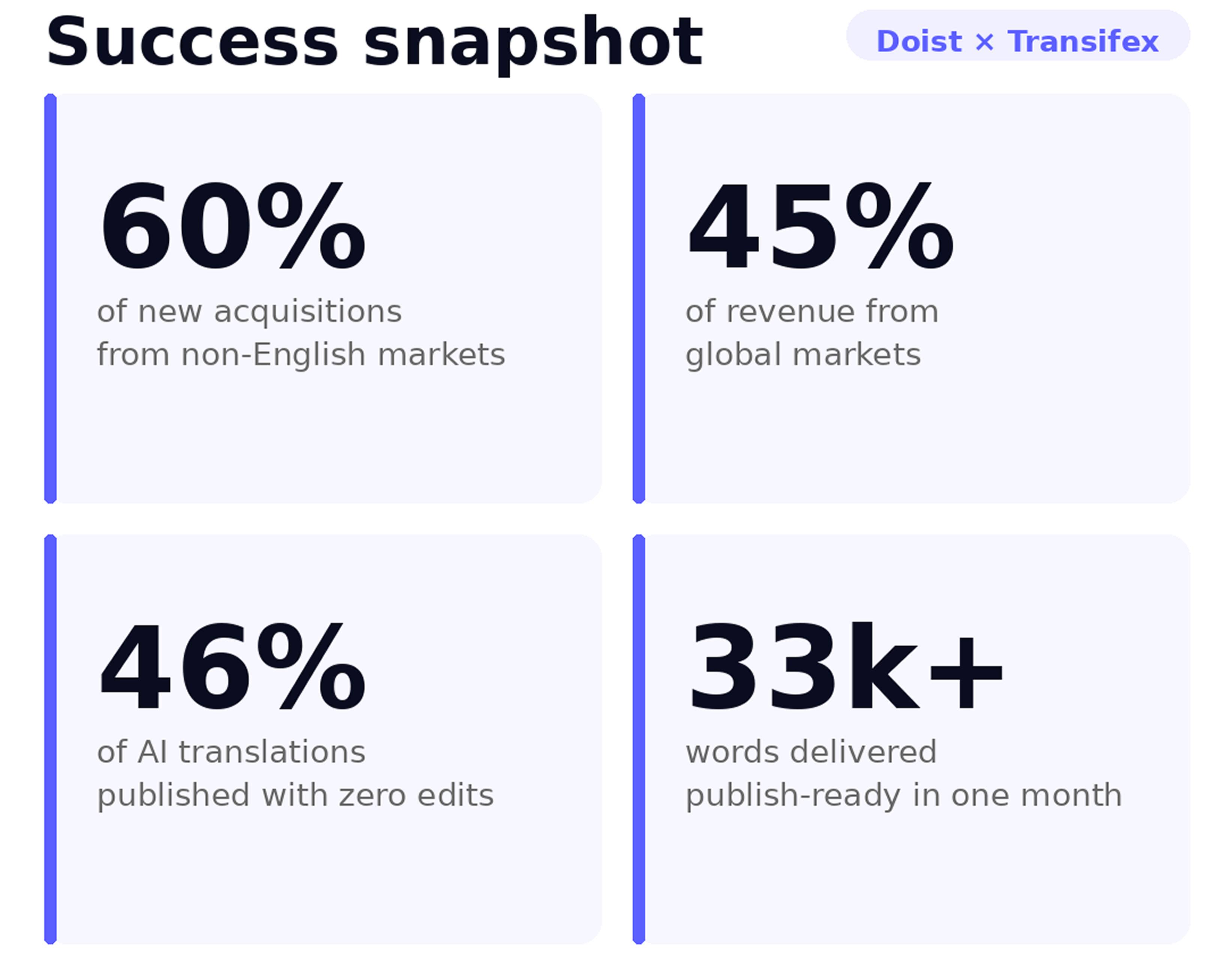
International growth is essential to Doist's operation. 60% of new acquisitions come from non-English-speaking markets, contributing up to 45% of revenue. For Doist, localization isn't just support work — it's growth infrastructure.
"Today, over 60% of our new acquisitions come from non-English markets, driving over 40% of our revenue. Transifex plays a central role in making that possible."
-Daniel Garcia, Sr Growth Marketer, Doist
The Challenge
By 2024, Doist was localizing across 18 languages with a high-performing program. But product shipping was accelerating, and a close look at where translator effort was focused revealed a problem.
51% of translation volume was support content — help center articles, instructional copy, product UI strings. Necessary, but not the work that required the highest level of human craft. Meanwhile, marketing content — the copy that shapes brand perception and drives acquisition — was competing for the same translator attention.
Start automating localization with Transifex AI
Growth was creating pressure that needed to be addressed with intelligent automation. The question became not whether to bring in AI but how to do it without compromising the authenticity Doist's brand depends on.
"We stopped asking how do we translate everything well and started asking how does human craft actually drive growth."
The Solution
Doist built a model that implements AI where it performs best and keeps humans where they matter most.

Working with Transifex, they developed a 70/30 framework: ~70% of content handled through an AI-first workflow with human post-editing, and 30% remaining fully human-led.
The right localization workflow is chosen based on funnel stage, not content type.
- Human-led — landing pages, app store listings, campaigns, onboarding. The brand-critical surfaces that drive acquisition and activation. Human translators own these completely.
- AI-first with human review — product UI, help center, lifecycle emails. Transifex AI translates; human reviewers sign off before anything goes live.
Underpinning it all: Transifex's translation memory and glossary features keep terminology consistent and improve AI output over time. Translators maintain both as living assets. Style guides are refined continuously based on real output — creating a feedback loop where better guidance produces better translations, and better translations mean less editing work.
"AI first, for us, is not automatic without control. The human review in context is non-negotiable — but what Transifex AI handles, it handles well, and it keeps getting better."
The Impact
With Transifex AI handling nearly half of all translations without needing a single revision, Doist's team reclaimed the time and headspace to focus on the projects that have the greatest impact on both the brand and the business.
Translator roles evolved, too. Rather than processing routine strings at volume, Doist's linguists became quality engineers and cultural stewards — applying their expertise where it matters most and directly shaping how Transifex AI performs over time.
And quality keeps improving. After refining their style guides inside Transifex, publish-ready output jumped by 20% — and the feedback loop keeps compounding. With every project, every human input, the system becomes more accurate and less reliant on manual touchpoints.
For a bootstrapped team localizing across 18 languages, that's a meaningful shift: more throughput, higher quality where it counts, and a localization program that scales with the business.